The Mighty Staysail
📄 Download PDFThe Mighty Staysail
By Bill Whitney
Looking at the typical 20 — 40 foot sloop-rigged Like all other sails, however, staysails have some
production sailboats built from the 1960s to the 80’s, there are __ limitations, wind range and points of sail to mention a few.
very few rigged with staysails. Almost all of them employed When sailing downwind on a very broad reach, the staysail can
big, overlapping genoa jibs to provide the sail power needed to __ interfere with the airflow to the jib, due both to the weight of
drive their hulls. Larger schooners and world cruisers the club, and the partial blanketing by the mainsail. I find that
employed staysails but these faded from popularity as produc- dropping the staysail can actually increase boat speed, as the
tion boats. Now, decades later, we see a resurgence of the full jib moves the center of effort forward to counteract the
staysail, not only in new boats, but also in many refits of older tendency of the boat to round up. Similarly, on a dead run, a
production boats, as people discover the limitations of the | Preventer or whisker pole which keeps the club ‘winged’ out on
single headsail rig. Heading upwind in a building breeze with a the opposite side from the mainsail, prevents the staysail from
big genoa, even if it can be efficiently roller-reefed, becomes a COllapsing. The staysail and club can become a weapon during
challenge. Too much sail overpowers the boat and reefing a 4M accidental jibe. Clubs tend to dominate the foredeck, and
large jib upsets the balance of the sail plan by shifting the can interfere with anchoring, keeping a bow watch on a foggy
center of effort too far forward. day, or storing a dinghy.
Designers and builders are now producing boats with The design elements your sailmaker has to consider
either permanent or removable inner stays attached to the mast, re the area and normal wind range in which you will be
with the inner triangle about 2/3 of the foretriangle area. Sailing, proximity to the mast and other sails, amount of inner
Conveniently, this is about the same sail area as a reefed/furled Stay sag on various points of sail, and desired location of the
jib. With a sail on the inner stay, the center of effort is moved center of effort for the sail relative to the overall sail plan. One
aft, and provides much better balance for the entire sail plan. Of the issues I have with my staysail is how much it disturbs the
On a Friendship sloop, this inner stay is attached to the mast at _ luff of the mainsail when close-hauled. The windward perform-
the same place as the shrouds, and approximately at the center ance would likely improve with a smaller staysail, or by having
of horizontal thrust for the reefed mainsail, thus providing a ™Y existing sail recut with some hollow added to the leach. If
strong, mechanically balanced structure. It’s amazing that it the staysail is too full, or the slot between leech and mainsail is
only took modern designers 50-plus years to “discover” the 100 tight (because of poor sail trim or shape), it will disturb the
staysail again! airflow and efficiency of both the jib and the mainsail, particu-
The staysail is a handy and versatile sail, almost effort- larly when sailing close-hauled.
less to tack or jibe, and easy to set or strike from the cockpit if Since the staysail often doubles as the heavy weather
properly rigged. This small headsail generates considerable Sail, robustness all around is imperative. The most failsafe
power on its own, and trimmed correctly, augments the Staysail arrangement is a hanked-on, loose-footed sail that’s
mainsail, amplifies the jib, and balances the center of effort on _Stoutly constructed and that’s sized and shaped conservatively.
many points of sail. Its fabric weight should be equal to or greater than the weight
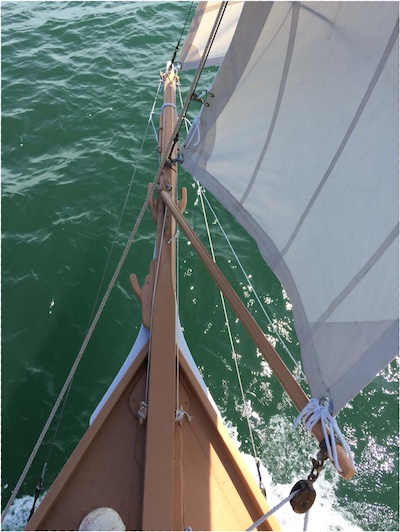
A clubfooted staysail has its foot secured to a boom, Of the mainsail cloth. Its corners should be heavily reinforced
hence the name “club” commonly given to that spar. Its foot With multiple layers of sailcloth, extending along twelve to
can be attached to the club with lacing, but more commonly it’s _ fifteen percent of the length of the luff, leech, or foot that
‘loose-footed’, attached only at its tack and clew. Ihave a short they’re supporting.
lanyard attached to the clew as an outhaul so I can give the sail The corner hardware should be non-corroding bronze
minor adjustments for wind conditions. In light winds I slack OF Stainless steel, built and installed to take the load of a
off the outhaul to give the sail a little more curvature, or draft, _50-knot gust. Webbing reinforcement may be added to enhance
and I tighten it up to flatten the sail as the wind increases. the strength and flexibility of the corner rings. The type of jib
Another alternative rig is to install roller furling, which hanks and the way they’re secured to the luff of a hanked-on
offers an easy way to deploy, furl, and stow a staysail from the _Staysail, make a huge difference in the reliability, ease of
cockpit, and with some set-ups, a way to reduce sail area by repairing, and handling of the sail. Jib hanks should be bronze,
partially furling, or roller-reefing. If the sailcloth is robust reusable, and large enough to allow an easy run up and down
enough for heavy weather, and the sail is adequately protected _ the stay, with piston pulls all on the same side.
from sun exposure when furled, a furling staysail may be a The venerable, valuable and versatile little staysail
viable option. adds much to a sailor’s options if it’s built for the task, and the
In heavy weather, the staysail becomes the ‘go-to’ Tig it’s flown on is designed to maximize its performance. This
foresail, providing just the right amount of sail area and headsail that consistently provides yeoman service, proves once
maintaining the same balanced center of effort under a double- again that good things do indeed come in small packages!
reefed main as exists with the full rig. Back-luffing it can also
be a big help getting on the right tack when sailing off the (Note: Much of the content of this article is a distillation of
anchor or mooring, and when coming about in heavy seas. The multiple sources, among them, “In Praise of the Versatile
staysail is at its best on any points of sail between a close reach Staysail”, by Carol Hasse, “The Sailmaker’s Apprentice” by
and a broad reach, and the self-tending ability of the club- miliano Marino, and “Sails”, by Jeremy Howard-Williams,
footed staysail is very useful in short tacking and 47d of course, YEARS of personal experience)
single-handing.