Loss of a Rudder – Preventing Electrolysis
📄 Download PDFThis column is a forum for sharing the vast range of practical
experience accumulated by our membership and not just my
favorite boat maintenance topics. It is intended to be the place
where you, the reader, can ask technical questions and either
obtain direct answers in this column or direction to appropriate
reference material
This article is another departure from my originally scripted
list of topics. In case you don’t remember, the topics were electri-
cal wiring, alternators and regulators, batteries, grounding and
bonding, radios and antennas, and instrumentation (depth, speed,
GPS, LORAN, etc.). But due to a recent problem experienced by
one of our members | think this maintenance advisory has to take
precedence. Although the incident occurred on one of the
Pemaquid models | think it could easily happen to any of our
boats.
The occurrence was the loss of a rudder. With a good degree
of skill on the part of the skipper and a little luck, he and his first
mate made it back to the mooring. No secondary damage was
done (as long as you don’t count the elevated blood pressure and
frayed nerves). But rather than an epic tale of seamanship the
focus of this article is how to prevent something like this from
happening to you.
If you recall, a few issues ago (Tech Tips #5) we discussed the
problems that can result from improper grounding and bonding
of an electrical system in a marine environment. Stray electrical
currents, induced either by the presence of dissimilar metals in
an electrolyte (like salt water), or those resulting from faulty
electrical wiring on a boat (either yours or one near yours) can
cause metals to waste away. And that’s what appears to have
happened in this case. The rudder was lost because the rudder-
post, a very substantial piece of bronze, was eaten through just
inside the top of the rudder assembly. When the helm was shifted
to steer the boat the torque was just enough to twist the rudder-
post apart, resulting in loss of steering and the rudder.
I have not had a chance to inspect the pieces, or have the
Materials Engineering folks at work offer their opinion, but
knowing a little about the construction standards applied in
building the boat, and the materials that were originally used, |
doubt that galvanic corrosion is the cause. It seems much more
likely that there is an electrical wiring problem on the boat.
Hopefully we will have time to troubleshoot that later this
winter. I highly recommend that you take the time to go over all
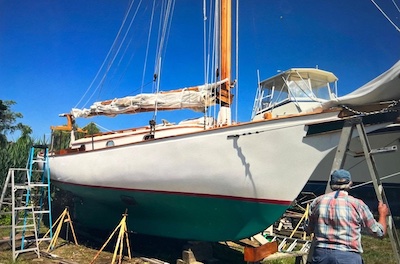
the fittings below the waterline while the boat is sitting high and
dry this winter and give them a thorough inspection.
What should you be looking for? Start with a good structural
inspection to see if there is any obvious weakness to the fittings.
Grab the interior neck of each through hull and give it a good
side to side, front to back push. Any quality bronze fitting should
be more than able to handle this side load, unless it has lost
considerable strength due to corrosion. It is important to remem-
ber that you may not be able to see any evidence of corrosion if
it is inside the fitting or underneath the hose. Wooden boats have
the additional problem in that the hull fastenings could be eaten
away in the same manner as the rudderpost but you can’t inspect
them unless you take things apart.
For items like the rudder you will more than likely need
another person to help you. Someone to hold the rudder and look
for any difference in movement between the shaft and body of
the rudder, and the other person to move the tiller or wheel.
Since most steering systems have a little slop in them (a little
slop is a good thing) the person on the helm won’t be able to feel
the difference between the steering slop and any difference in
movement between the rudder and its’ shaft. The person holding
the rudder may need to feel the difference rather than see it.
Obviously if you can see the rudder shaft move and the rudder
doesn’t you have a significant problem. Even the smallest
movement of the rudder shaft in a fiberglass rudder assembly,
while the rudder is being held in a fixed position, needs to be
investigated. Movement could be indicative of a severely
weakened shaft, like the one that was the genesis of this article,
or a web structure problem inside the rudder that has loosened
and you have voids in the rudder that very likely have water in
them. The winter freeze and thaw cycles will continue to take
their toll until delamination causes a structural failure. If you
find any cracks in the fiberglass, you may already have a delami-
nation problem.
Other items that should be inspected is the fit of the propeller,
tightness of the prop nut and jam nut, possible bends in the prop
shaft, totally wasted zincs or the possibility of a wom rudder heel
bearing. If you find that the zinc is severely wasted, or
worse…..gone after one season, you really should inspect the
submerged fittings thoroughly. Under normal conditions the
bronze fittings exposed to salt water should be a nice chocolate
brown color. As you are looking at all the fittings be conscious
of their color. If they look as though they have a pink hue it
could indicate that they are being depleted. If any of these items
are corroded take action to fix them before the boat goes back in
the water.
I know it might be cold and it’s raining, blowing, snowing and
being otherwise miserable, but a little time on and around the
boat performing a good visual inspection, and mechanical integ-
rity testing, will make the good summer weather a lot less stress-
ful and it will just seem to last longer.