Knives
📄 Download PDFMarlinspike Seamanship
By Ted Walsh
Knives
A good knife is a pretty indispensible tool to have on a boat,
or anywhere else for that matter (ask Judy how she got out of the
bathroom at work when she accidentally got locked in). There are
plenty of styles and types of knives to choose from without even
touching on multi-tool knives. Whatever type of knife you prefer,
however, there are some basic truths about knives that are worth a
quick review:
First, a knife should always be handled with care. There are nu
merous ways to get hurt on a boat, cutting yourself with your own
knife should not be one of them.
Second, keep your knife sharp. This might seem counterintui
tive to the first item, but the reality is a dull knife is more danger
ous to use. More force is needed to make the blade do what you
want it to, which leads to slips and losing control of the blade.
Third, a knife is first and foremost a tool. If your knife is so
valuable, or so precious that you are afraid of using it, then it
should be left at home. Put your heirloom in a glass case and carry
something that won’t make you cry if it falls overboard. I repeat it
is first and foremost a tool.
Fourth, well-used knives wear out; it is okay to replace them.
The type I carry with me all the time wears out and gets replaced
about every three years.
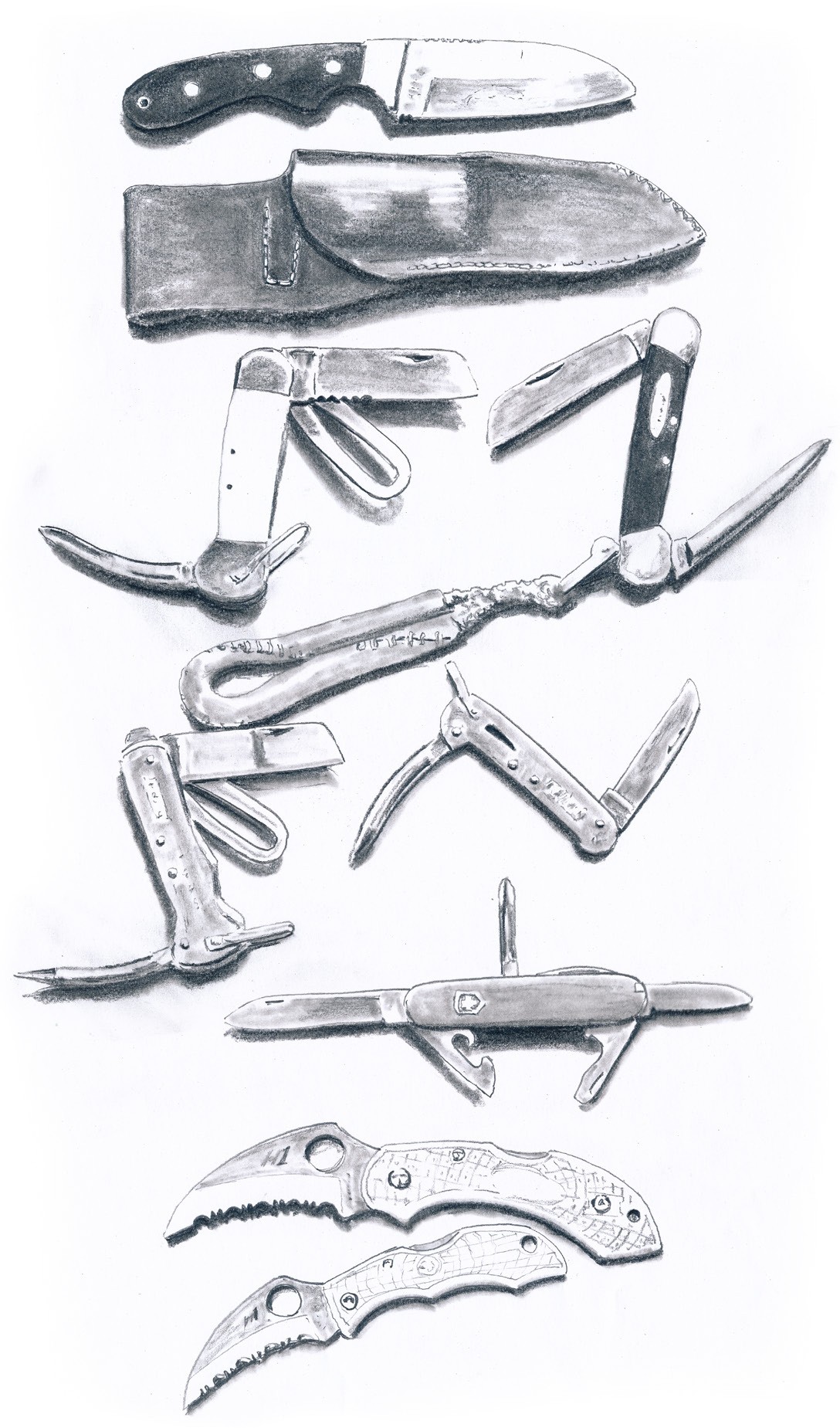
Fifth, it is okay to have more than one. Judy carries a folding
Navy issue knife with marlinespike. I carry a two-blade Swiss
army knife pretty much all the time. We also have several aboard
our Friendship, a large fixed-blade sheep’s foot knife for heavy rig
ging work, and two different sizes of folding rigging knives in the
rigging bag and in the make-and-mend bag.
Sixth, dropping a knife is a bad idea. Dropping a knife over
board is also a bad idea.
This brings up the topic of lanyards and there is no hard-and-fast rule here. The problem with knife lanyards is that
they tend to get caught on everything as you move around the boat, which in itself can be a dangerous situation. Lanyards
can also get in the way when you are working and make knife work more difficult. On the other hand going aloft, out on
the bowsprit, or hanging over the side without your knife on a lanyard is asking for trouble. Just as we have several dif
ferent kinds of knifes on board, so too we have several different lanyards on board and can whip one up in a hurry too if
needed. (A future marlinspike will be devoted to knife lanyards).
Seventh, did I mention that dropping a knife is a really bad idea? When you are not using it, your knife should be kept
in such a way that it couldn’t fall out of a sheath or pocket onto a deck or someone’s foot.
A few notes on knives in general:
Folding knives: these should have a good stiff spring. A good spring is critical to not having the knife accidentally
close on your fingers. If the spring gets soft, get a new knife. The best folding knives lock open and lock closed. What I
like best about folding knives is that they fit in a pocket making them harder to drop.
Sheath Knives: the sheath is as important as the knife. No matter what type of blade or handle you prefer, the bot
tom line is, if you can’t get it back into the sheath without stabbing yourself, it’s not safe to use. If the knife falls out of
the sheath, it is dangerous. One more thing on sheath knives, it should have a hole in the handle to attach a lanyard. If it
doesn’t, leave it at home or use it for cooking.
Serrated blade or straight blade: this is mostly a question of use and preference. A serrated blade is better for cutting
through a line in a hurry but a straight blade will make a cleaner cut without pulling apart strands.