Tech Tips #19 – Cruising Lessons
By Bill Whitney
I don’t have my logs or a chart in front of me as I write
this, but based on previous years’ logs the Buzzards Bay Fleet
averages almost 400 nautical miles each year on our round trip
excursion from Cape Cod, MA to the shores of Rockland, ME
and beyond. We don’t claim to be expert cruisers, but we are
getting pretty darn good at it and we have a lot of fun along the
way. Over the years we have coped with anchor, engine, electrical
and bilge pump problems, and the full range of navigation,
accommodation, and even restaurant reservation issues. We dealt
with the difficulties, learned from them, had a wonderful time in
the process, and importantly, we did it in the company of fellow
cruisers. It’s sort of like bringing your own maritime support
group with you. As the saying goes, there’s safety in number
Based on our experience I would like to offer something
of a challenge: join us!! Better still, get your own local fleet
together and become cruisers. It will make you better sailors. This
excerpt from “How to Sail Around the World” by Hal Roth,
reaches a little beyond what I’m advocating but it makes an
important point.
“Cruising under sail is a hundredfold more complex
than merely buying a suitable yacht. We know this because the
marinas and harbors of the world are dotted with private pleas-
ure craft, most of which go nowhere at all. There are tens of
thousands of boat owners but very few sailors. Pay attention to
this phrase: lots of boat owners but very few sailors. And a sailor
you must be if you’re going to try ocean voyaging. You need a
modicum of sailing aptitude, some ability to fix things, and the
willingness to pitch in and work.
Most veteran long-distance small-boat sailors are free
spirits who fall into the classification of restless adventurer and
who are always looking at distant horizons and trying new
things. These spooky engineers usually lack fancy certificates,
but they’ve all served fairly intensive apprenticeships and have
learned a good bit about the sea, the care of their vessels, and
the management of themselves.
To learn the fundamentals of sailing, you need to go toa
special school for a few weeks. You will be taken out in a dinghy
or small vessel for instruction in sail handling, tacking, gybing,
docking, maneuvering in restricted waters, and following safety
procedures. Then you must practice as often as possible and
serve as crew for friends on their yachts.
In the beginning, you will only be a grunt, but little by
little it will come to you. Every time you sail on a different vessel,
you learn a thing or two because each captain has his own way
of doing things. You need to find out about anchors and rigging,
and to get some notion of sanding and painting and fixing things
because life under sail is a never-ending round of maintenance,
modifications, and large and small repairs.”
Now, if you grew up in and around boats, you won’t
need a special school to teach you the rudiments of sailing, but
regardless of your level of formal training, the best way to
advance any of your skills is to use them. Add the safety and fun
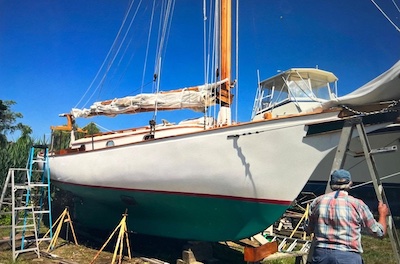
factor of sailing in a small fleet of friends in Friendship sloops,
and you have the best learning environment imaginable. So find a
like-minded soul or two, and come join us or plan your own
cruise. See you on the water!