Jack Stands
📄 Download PDFTech Tips #14 – Jack Stands
by Bill Whitney
Have you ever been doing something, something that
you have been doing for years, something that’s so common that
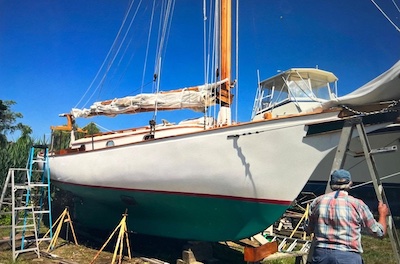
you never thought much about it? Putting the boat up for the
winter is sort of like that for me. After 30 or 40 years of boat
ownership, everything is almost automatic. There will be excep-
tions now and then, depending on the changes that were made
over the season, but nothing that alters the basic process. Empty
the boat, fog the engine, top up the fuel, haul her, set up the
blocks and stands, and toss on the cover. What could be simpler?
But I’m cursed! Nothing is ever simple! I always get
myself in trouble by wanting to know too much. Don’t ask me
why I started thinking about blocking and boat stands. The boat
has not fallen over, ever! Since the yard always hauls the boat
and sets her up on the blocks and places the stands along her
sides I never get directly involved. Nevertheless, for some
strange compulsive reason I wanted to know what the specifica-
tions on boat stands were. So armed with this almost obsessive
engineer’s curiosity | hit the internet for some answers.
The internet is a great resource and manufacturers are
more than willing to share information on their products.
Distributors, such as West Marine, Jamestown Distributors and
others have great links to their suppliers that are loaded with data
and general information. Brownell is no exception. They have a
great “Boat Stand Selection Guide” that gives you all the infor-
mation you need for setting up your Friendship Sloop, lobster
boat or trawler safely and securely.
One thing that did jump out at me was the recommenda-
tion to place the stands approximately 8’ apart. The yard usually
places them at twice that spacing. I don’t think it has anything to
do with the bulkhead spacing, since that’s where they are usually
placed but I need to speak to the foreman just to be sure! Below
are several paragraphs that are directly from the selection guide.
“The correct type of boat stand (sailboat vs. motorboat)
is determined by the angle between the hull and the stands center
pipe. The threaded rod from the top that enters the stand’s center
pipe should do so at approximately a 90 degree angle to the
boat’s hull. For example, a motor boat with a deep vee bow
would use a pair of sailboat stands at the bow, with motor boat
stands at the stern.
To determine the proper Brownell Boat Stands to use,
you must realize the boat stands are to stabilize your boat and the
keel blocking supports the boat’s weight. A simple method
would be to take the draft in inches, add the height of the block-
ing, and subtract about six inches. Base your decision on keeping
a minimum amount of thread exposed on the top.
A minimum of four boat stands should be used with
powerboats and a minimum of five boat stands should be used
with sailboats. One exception: a full keel sailboat may not
require a bow stand. Use a pair of boat stands, one placed port
and one placed starboard, for approximately each 8 feet of the
boat’s length. If you are going to be stored in an extremely windy
area or leaving a sailboat mast stepped, extra boat stands should
be used in addition to our minimum requirements.”
If you, or the yard where you store the boat, are not
conforming to these recommendations perhaps you need to think
about what your insurance company may say if (God forbid)
there is an accident. In retrospect, I’m glad my curiosity lead me
to the Brownell site. This old dog learned a new trick.